How Trumpf builds quality assurance into its manufacturing process

5 Mins
Published in Quality & Inspection
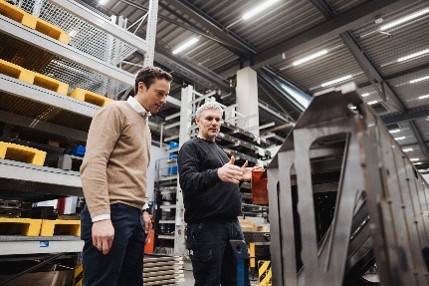
For machine tool manufacturers, the measurement of quality ultimately takes place on the customer’s production floor. A component defect, software issue or process deviation can translate into machine downtime, delayed orders and disrupted production schedules. At the Ditzingen, Germany site of sheet metal processing machinery specialist Trumpf, the approach is to address those risks much earlier.
Rather than treating quality as a final inspection step, Trumpf integrates quality assurance throughout the value chain, from incoming goods and production through to software testing and technical service. The objective is to identify deviations as early as possible, reduce the risk of downtime and provide greater reliability around delivery dates and production planning.
“We believe quality is not just a test for completion at the end,” asserts Johannes Böttcher, Head of Quality Machine Tools at Trumpf. “It runs through the entire value chain.”
For Johannes, a defective component is only part of the issue. Just as important is understanding what the defect says about the process that produced, accepted or failed to detect it: “If something isn’t running optimally, our aim is to scrutinise processes continuously and take countermeasures as quickly as possible.”
Quality starts before production
That philosophy is visible at goods receipt, where components arriving from suppliers and other Trumpf plants undergo assessment before entering production.
“Everything that leaves the store must be of precisely defined quality,” he remarks. “We don’t deliver parts that fall short of our requirements.”
This principle reflects a preventative rather than reactive approach. Trumpf addresses supplier requirements, processes and quality standards before components reach the manufacturing line.
Marielouise Schäferling (pictured below), Head of Corporate Quality Management at Trumpf, says early detection requires building into the system rather than leaving to final inspection.
“Quality is not something you check at the end,” she says, echoing the sentiments of Johannes. “It must be system-integrated in such a way that the detection of deviations occurs at an early stage and responsibility is clear.”
The later deviation identification takes place, the greater its potential impact on subsequent operations, throughput time, costs and, ultimately, the customer’s delivery schedule.
Bringing quality on to the production floor
Inside production, Trumpf organises its quality activities around individual product groups. Teams bring together representatives from quality, development, production and service, with a quality assurance representative, known internally as the QSV, connecting these functions during day-to-day production.
This structure makes quality an active production responsibility rather than a separate function that intervenes only after something has gone wrong.
Finding a defect is only one part of successful quality control. The objective is to identify it at the earliest possible stage.
“Our aim is for the worker to recognise the fault immediately,” states Quality Officer Thomas Kieferle.
Every additional manufacturing stage completed before the identification of a defective part can add cost and consume production time. In a complex machine-building environment, this can ultimately affect throughput and delivery commitments.
The approach also relies on clearly defined responsibility.
“Standards only help if someone is responsible for them,” declares Marielouise.
Testing before the machine runs
The same philosophy extends beyond physical components.
In Trumpf’s Testing Department, engineers use software and simulation to reproduce machine behaviour digitally. The aim is to identify software-related problems before they occupy, or stop, a physical machine.
“We’re trying to simulate machine behaviour digitally,” sets out Stefan Sailer, R&D Manager for Testing and Second-Level Support in Technical Service.
Such an approach allows engineers to investigate a wider range of conditions while reducing the need to use production hardware for every test.
“We can simulate many more scenarios than on the actual machine and do not cause any idle states,” adds Stefan.

Digital simulation does not yet reproduce every aspect of the physical manufacturing environment. Material flows are not fully represented, while some effects still require testing on an actual machine. Nevertheless, the objective is to shift learning and fault detection upstream, where corrections can take place before a problem becomes operational downtime.
“We gain an advantage if we avoid mistakes before damage occurs,” remarks Marielouise. “The earlier we learn, the more we can reduce the disadvantage for ourselves and our customer.”
This preventative approach has also contributed to tools such as Trumpf’s ‘Cutting Assistant’.
Service closes the quality loop
Even with controls in development, incoming inspection, production and testing, machines operating at customer sites remain an important source of quality information.
Technical service therefore plays a critical role in Trumpf’s quality system. A breakdown, error code or seemingly minor service request can reveal information relevant beyond an individual customer case.
According to the company, more than 80% of service cases are resolved remotely or by telephone. Technical guides provide customers with solutions for known error codes, helping to address established problems without immediately requiring an on-site visit.
“We’re not a call centre,” emphasises Bernhard Kohl, Head of Internal Service – Bend. “We employ real experts here.”
Where remote support is insufficient, Trumpf aims to send a service engineer who is already familiar with the problem.
“Depending on the fault in question, we send a service engineer who is already familiar with the problem,” says Tobias Böschek, Head of Field Service – Bend. “This is how we ensure that the machine is up and running again quickly and that the customer can process orders.”
The quality function continues after resolution of the immediate problem. Information gathered by technical service is fed back into development, testing and quality planning, turning field experience into an input for future products and processes.
Technical service effectively becomes an early warning system. A problem identified on one machine can provide information that helps Trumpf prevent similar issues elsewhere.
From inspection to continuous feedback
What emerges at Ditzingen is a quality model built around a continuous feedback loop.
Incoming-goods controls seek to prevent unsuitable components from entering production. Production teams work to identify deviations as close as possible to the point where they occur. Digital testing moves software validation away from physical machines where possible, while technical service feeds information from the installed machine base back into engineering and quality planning.
The common objective is to move detection earlier. Earlier detection can reduce rework, costs and disruption internally. For customers, it can mean fewer interruptions, more predictable delivery schedules and greater confidence in production planning.
For Marielouise, however, making that system work requires more than procedures and inspection criteria: “Quality thrives on feedback. And on leadership.”
That helps explain why Trumpf treats quality not as a department positioned at the end of manufacturing, but as an operating principle connecting suppliers, engineering, production, testing and service.
“Quality is not an added extra,” she concludes. “It’s the foundation for everything.”
Want to know more about this article?
Ask us below...